role: full-stack engineer

full-stack, most of the time. the other times are called debugging.

Vidhaan Kothari · CS + Business student at UMass Amherst

about

A bit about me

The short version, before the project section makes the long version obvious.

Portrait of Vidhaan Kothari

CS + Business student at UMass Amherst, building across the stack, from real-time backend systems to the interfaces people actually touch. I've shipped a messaging system with sub-50ms latency, architected a production booking platform end-to-end (database, security, automated pipelines, and the UI on top), and built a Monte Carlo risk-simulation engine that won a hackathon's top track. I like understanding a system fully, front to back, not just the part I'm most comfortable in.

stack

Tools of the trade

Languages

Python
Kotlin
Swift
Java
TypeScript
SQL
Go
C
C++
Dart
HTML/CSS

Frameworks / Libraries

React
Node.js
Next.js
Android SDK
Express
FastAPI
Flask
Django
Spring
PyTorch
Pandas

Cloud / Database

AWS
GCP
MongoDB
MySQL/PostgreSQL
Redis

Tools

Git
Docker
CI/CD
Prometheus
Grafana
MLflow
Jenkins
Jira
Linux
JUnit
Espresso
Jest
Splunk
Agile

projects

Things I've built

Some things that mostly worked. In roughly that order.

flagshipprivate client project

BB Lux Inc.

Transportation booking platform · Full-Stack Engineer Intern, June 2026 – Sep 2026

production system · 1,000+ historical rides · 8 drivers

Architected and shipped a production SaaS-style booking platform for a private transportation company, replacing manual WhatsApp-based operations with a fully automated, secure, real-time booking pipeline.

  • Normalized PostgreSQL schema with Row Level Security: anon role restricted to insert-only, zero public read access
  • Secure server-side booking pipeline: input sanitization → validation → parameterized insert → transactional email → webhook sync to Google Sheets
  • Layered security: SQL injection prevention, XSS/CSRF mitigation, CSP/HSTS headers, rate limiting, honeypot bot detection
  • Real-time multi-channel sync: every booking simultaneously hits the database, sends a transactional email, and updates a live spreadsheet for the business owner
  • Production deployment on Vercel with custom domain, environment-scoped secrets
Next.js 14 (App Router)TypeScriptPostgreSQL (Supabase)Resend APIGoogle Maps Places APIMake.comVercelTailwind CSSFramer Motion
hackathon finalisttop 20 of 250+ teams

Fathom

Ocean decision tool for Massachusetts waters · built in 24 hours

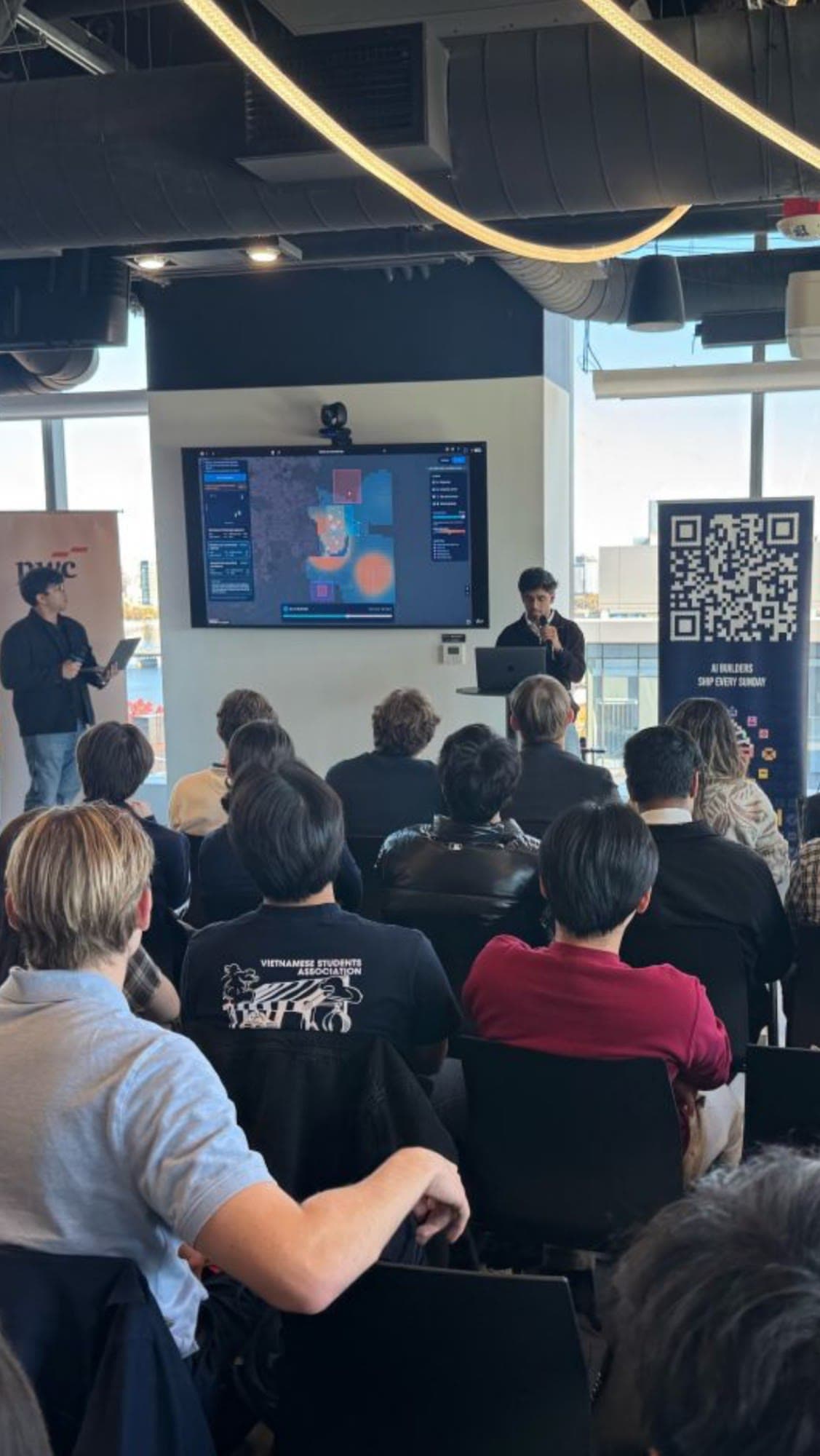
Hackachusetts 2026 · Climate Tech finalist · pitched live at WHOOP HQ

An advisory tool for protecting endangered right whales off Massachusetts. Fishing captains get ranked routes that avoid whale closures, speed zones and bad weather, and harbor managers can test a protection rule to see the whale risk it removes against what it costs the fleet. A deterministic engine does all the math on live NOAA data, every explanation cites its source, and the interface works in English, Portuguese and Spanish.

  • Built the explanation layer that narrates why each route ranks where it does, with a cited source on every claim
  • Wrote evaluation tests that check those explanations against the deterministic routing engine, then fixed the citation errors they exposed using real NOAA data
  • Redesigned the simulator presets so each one shows a measurable effect, for example about 35% simulated whale risk removed
  • Ran QA and audit rounds that caught production bugs (CORS, 500 errors, dead source links), each fixed with a regression test
  • Coordinated a team of four through a 24-hour build, shipped live with 240+ automated tests and CI on every push
PythonFastAPIReactTypeScriptTailwind CSSMapLibredeck.glDockerVercelRender

Chronexis

won top hackathon track award

Chronexis venture brief input form

A predictive project-risk simulation engine. Runs 800 Monte Carlo simulations against a venture's parameters (team, deadline, runway) to forecast delivery timelines, failure probabilities, and resource bottlenecks, producing risk heatmaps and automated executive recommendations.

TypeScriptNode.jsMongoDBMonte Carlo Simulation

SwipeSwap

SwipeSwap sign-in screen

A swipe-based peer-to-peer marketplace app. Models implicit user feedback to learn personalized item rankings, using content-based similarity scoring and vector embeddings to dynamically adapt recommendations as preferences evolve.

PythonFastAPIPostgreSQLscikit-learn
source private

Finter

sold 377 tickets · organizer costs cut about 10%

// finter: event ticketing platform
const architecture = {
roles: 'organizers + attendees',
payments: 'Stripe',
backend: 'Firebase data + auth',
delivery: 'automated EmailJS',
};
// results
→ 377 tickets sold
→ organizer costs cut ~10%
→ real-time attendee tracking

A dual-role event ticketing platform with dynamic event creation, real-time attendee tracking, and Stripe payments, backed by Firebase with automated delivery through EmailJS.

ReactNode.jsFirebaseStripeEmailJS

experience

Where I've worked

  1. ChitChat Workplace

    May 2025 – Aug 2025

    Software Engineering Intern · Boston, MA

    • Built a real-time 1:1 messaging system using WebSockets and event-driven architecture with under 50ms end-to-end latency
    • Designed a scalable AWS backend (EC2, API Gateway, DynamoDB) for high-concurrency traffic
    • Implemented JWT-based authentication and authorization for secure message delivery
    • Optimized DynamoDB indexing, reducing API response times by 20% under peak load
  2. Smartwatch Interface Research

    May 2025 – Aug 2025

    Undergraduate Research Assistant · Amherst, MA

    As part of a human-centered AI research lab at UMass Amherst, I built a pipeline that bridges raw sensor data and visual communication. It takes live smartwatch data and uses large language models, including Claude and GPT-4, to automatically generate structured SVG visualizations. The hard part wasn't the generation itself. It was making outputs consistent and interpretable across wildly different data inputs. That meant building constraint-aware layout logic, then designing a full evaluation framework across 10 quantitative metrics covering interpretability, visual fidelity, and consistency. I ran the whole iteration cycle myself, from prompt design to validation to latency optimization, until the system was reliable enough for production use.

  3. IExchange · Brainworx Infovision

    May 2024 – Aug 2024

    Backend Developer Intern · Remote

    • Refactored high-traffic SQL queries via indexing and normalization, improving dashboard load times by 12%
    • Built Python automation to classify and route support emails, cutting average response time by 7%
    • Diagnosed and resolved database deadlocks, reducing system downtime by 10%

University of Massachusetts Amherst

May 2028 (in progress)

B.S. Computer Science (AI Concentration), Minors in Business & Mathematics

AlgorithmsData StructuresWeb ProgrammingOOPComputer SystemsAdvanced Database SystemsSoftware DesignProbability & StatisticsLinear Algebra